
Google Dining
A Seat at the Table
Designing inclusion into the communal dining experience through a Google-native digital twin that proactively matches your dietary profile to restaurants and group preferences, so no one has to navigate that awkwardness at the table.

My Role
Product Researcher & Designer


Dining
Dining
10:01
10:01
10:01
10:01
Meet Guannan G!
Meet Guannan G!


Vegan
Vegan
Lactose Intolerant
Lactose Intolerant
Gluten-free
Gluten-free
Guannan G will make sure your recommendations are catered to these needs!
Guannan G will make sure your recommendations are catered to these needs!
Start your Dining Journey!
Start your Dining Journey!

Overview of my Contributions
As part of a five-person team on Imperial College's Impact module, I led the UX and UI design of the concept across four weeks, from ideation through to a fully resolved interface. My contributions spanned secondary research, field immersion, and collaborative ideation before I took ownership of the product's visual and interaction design. A significant part of my design work focused on the AI interaction layer, I designed the conversational flows and interaction patterns for Gemini's voice interface and chatbot assistant, mapping dialogue states, designing for ambiguous inputs, and ensuring the AI felt like a natural extension of the user's intent rather than a separate tool to learn. This wasn't cosmetic AI integration; the chatbot and voice system are the core interaction model, built to absorb the cognitive and social burden that our research showed users were carrying every time they tried to eat out.
Methodology
Field Research (camp visits + interviews)
User Ecosystem Mapping
Information Architecture
Paper Wireframing
Prototyping (Lo-fi to Hi-fi)
Moderated User Testing
Design System Development
01 Early Problem Framing
1 in 4 People live with Dietary Restrictions
Shared meals are one of life's great joys; but for the 1 in 4 people with a dietary restriction, they're often a source of anxiety, social awkwardness, and logistical friction. Our team tackled this as a service and product design challenge: not just the moment of eating, but the entire journey from discovery to review.
This was only a month long university project from discovery to concept, which meant our first step was to frame a brief.
Early Brief Framing

How might we increase the transparency of allergen information to facilitate a stress-free relationship between people and restaurants?

This was supported by our initial desk research, user interviews and stakeholder mappings.


We conducted Interviews with individuals with dietary restrictions, restaurant owners and staff.
Here’s what we heard!
Fruit & Alcohol Allergy
“ I am constantly worried that in professional settings, saying no to certain foods and alcohol might be considered rude and will impact my opportunities”
-Martin
Celiac
“ I feel like I am always limiting the my friend groups options for eating outside, which pushes the price range and leaves me feeling guilty”
-Audrey
Restaurant Server
“Guests do not normally seem hesitant to disclose dietary needs, they either say it up front or they answer when the question about ‘Are there any allergies’ has been asked.”
-Riggs Hotel
02 Research & Discovery
We went for a Hot-Pot!

Before mapping the journey, the best way we felt we can understand the subject matter is by immersing ourselves into it. Our group member Mike is a celiac who graciously agreed to go for a hot-pot with us!


Following this, we built a user journey map to better understand where and when did the pain points occurred.
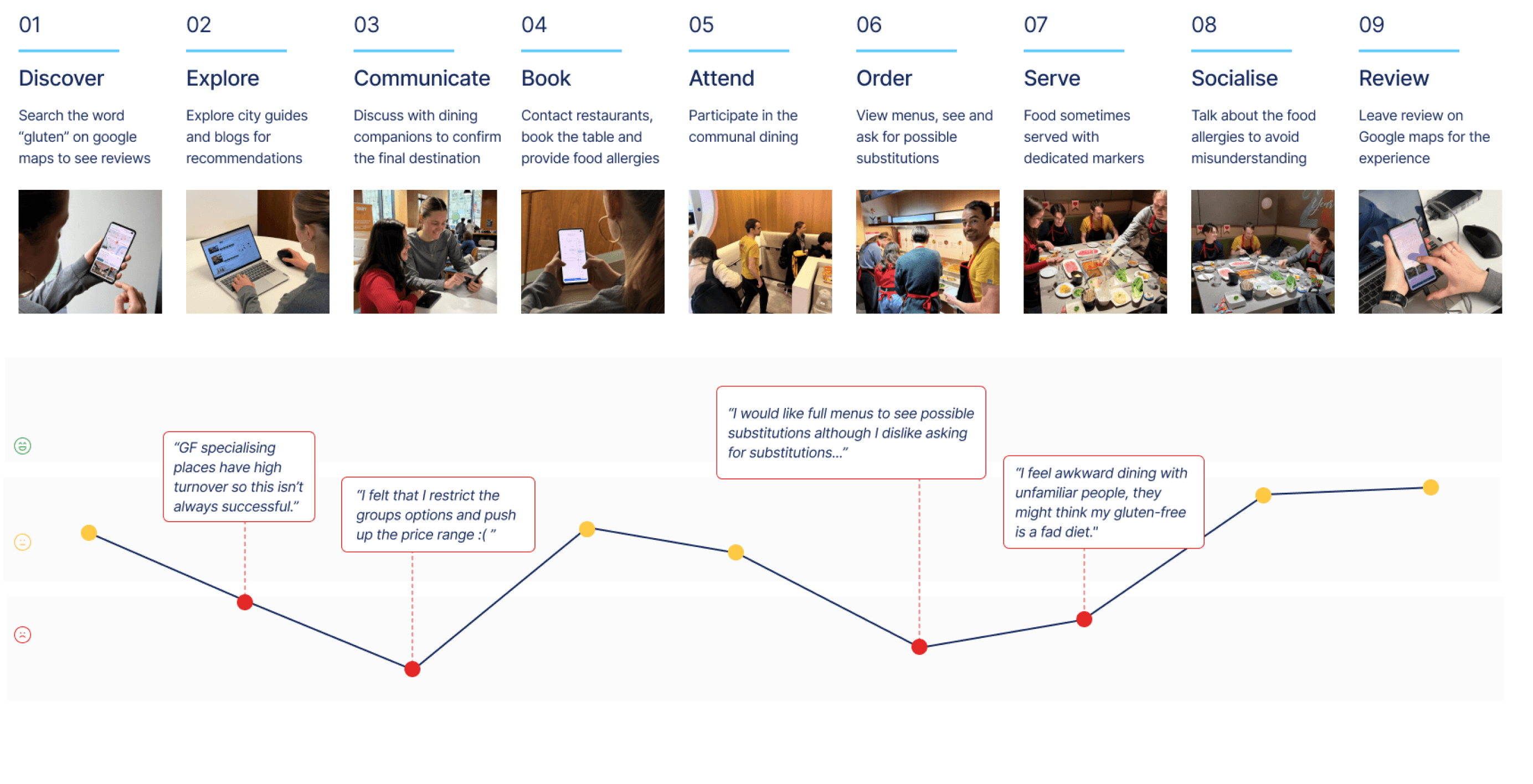
These were some of the insights derived from the research which helped us frame an actionable HMW -
Exploration
People with allergies rely heavily on Google reviews, but high turnover and outdated information means the search is unreliable and stressful which kills the spontaneity!
Pre-Dining
People fear being perceived as ‘fussy’ or following a fad diet, causing anxiety before they even arrive at a restaurant. This stress leads to avoid disclosing allergens entirely, creating a quiet but serious safety risk.
Dining
People with allergies have deeply personal perspectives on dining shaped by past reactions which makes them hesitant to speak up; an equitable approach must actively encourage them, not wait for them to ask.
03 HOw Might we
Turning Friction into Focus
With our research mapped, we needed to distil what we'd heard into a single design direction. The pain points clustered around four tensions - decision fatigue, social discomfort, kitchen opacity, and a lack of tailored platforms; all pointing to the same underlying gap: dining information was built for the average person, not the one in four who needs more. This became our new How Might We.
How might we make restaurant information more accessible and tailored to cater to the dietary needs of all individuals?
Decision Fatigue
Social Discomfort
Kitchen Opacity
Lack of Tailored Platforms
unreliable and outdated reviews
add to the mental load
Disclosing restrictions feels awkward or stigmatising
Under pressure, chefs face
cross-contamination challenges managing allergies
Booking platforms rarely account for personal dietary needs

04 design decisions
Your dietary twin does the work
Every friction point we uncovered had the same root cause: people were doing the work themselves - researching, disclosing, negotiating, worrying, every single time they wanted to eat out. The solution didn't need to be a better search filter or a clearer menu label. It needed to remove the burden entirely. We landed on the idea of a dietary twin - a persistent profile that lives inside Google's existing ecosystem, knows your restrictions, and does the matching, filtering, and communicating on your behalf. Because Google already sits at the start of most people's restaurant discovery journeys, embedding the twin here meant zero additional friction to adopt it, and maximum reach for the people who needed it most.
Digital Twins · Real Dinners
A Google Dining feature where each user has an AI digital twin that proactively surfaces dietary-safe restaurants, synthesises data from reviews and visits, and shares anonymised insights with restaurants; all without the friction of manual research.
Real World
Scrapes reviews, generates preference insights, delivers data back to restaurants
Digital Twins
AI agent with personal dietary profile, proactive synthesis, inter-user collaboration

Data Lakehouse
Scalable ML training on structured + raw data as network grows
Designing for Google's ecosystem
Fingerprint as Twin Key
“Try Together" Dishes
Gemini Integration
Biometric auth ties your dietary profile to a single identity - no login friction, no disclosure moment at the restaurant.
Surfaces options that work for everyone at the table - shifts the experience from accommodation to genuine inclusion.
Gemini's voice search lets users query naturally, while every review feeds a shared data lake house - making results smarter over time.

05 Validation
Validated Across the Table
We tested the concept with target users and mapped its value across the full ecosystem. Privacy concerns we anticipated never surfaced - users felt Google already held this data, so having it work for them felt natural rather than invasive. The concept resonated on every level: reducing friction for individuals, generating actionable insights for restaurants, and slotting seamlessly into Google's existing infrastructure.
Immediate Integration
Can be integrated into current Google digital experience with an extra layer of sophistication to Google Reviews, restaurants reviewed more passively post-dining, via voice interaction.
Builds upon Google’s context-aware food recommendation technology patent.6
User Feedback
Target users showed enthusiastic support of the concept. It was found that our initial privacy concerns were not expressed.
People felt that location data, purchases and preferences were already collected so it felt transparent to have them benefit the users.
Restaurants Benefits
Releases diner information to generate statistical insights into dining behaviours. Restaurants can make more data-driven business decisions.
Allows restaurants to respond to the market quicker and with greater precision. Lowers administrative burden on smaller restaurants.
Individual Benefits
Streamlines the pre-dining user experience for those with specific dietary requirements and those dining in groups.
Reduces the speculative phase of identifying a restaurant that can meet personal and group requirements. Increases certainty of decision making.
06 reflection
What dining with my coeliac friend
taught me about design
The field visit wasn't just a research method, it was the frame through which every decision afterwards made sense.
Social stigma is a design constraint, not a communications problem
You can't label your way out of the discomfort of disclosing a restriction. The design has to remove the moment of disclosure entirely — or make it invisible.
Adoption lives where behaviour already lives
People already search for restaurants on Google Maps. The best solution was one that augmented that existing habit - not one that required starting a new one.
Designing for groups is harder; and more worthwhile
Single-user experiences are simpler to design. But the real stress of dietary restriction happens in groups. Designing for the whole table, not just one person, is where the meaningful impact is.

Thank you for reading :)
Google Dining
A Seat at the Table
Designing inclusion into the communal dining experience through a Google-native digital twin that proactively matches your dietary profile to restaurants and group preferences, so no one has to navigate that awkwardness at the table.
My Role
Product Researcher & Designer
Dining
10:01
10:01
Meet Guannan G!
Vegan
Lactose Intolerant
Gluten-free
Guannan G will make sure your recommendations are catered to these needs!
Start your Dining Journey!
Overview of my Contributions
As part of a five-person team on Imperial College's Impact module, I led the UX and UI design of the concept across four weeks, from ideation through to a fully resolved interface. My contributions spanned secondary research, field immersion, and collaborative ideation before I took ownership of the product's visual and interaction design. A significant part of my design work focused on the AI interaction layer, I designed the conversational flows and interaction patterns for Gemini's voice interface and chatbot assistant, mapping dialogue states, designing for ambiguous inputs, and ensuring the AI felt like a natural extension of the user's intent rather than a separate tool to learn. This wasn't cosmetic AI integration; the chatbot and voice system are the core interaction model, built to absorb the cognitive and social burden that our research showed users were carrying every time they tried to eat out.
Methodology
Field Research (camp visits + interviews)
User Ecosystem Mapping
Information Architecture
Paper Wireframing
Prototyping (Lo-fi to Hi-fi)
Moderated User Testing
Design System Development
01 Early Problem Framing
1 in 4 People live with Dietary Restrictions
Shared meals are one of life's great joys; but for the 1 in 4 people with a dietary restriction, they're often a source of anxiety, social awkwardness, and logistical friction. Our team tackled this as a service and product design challenge: not just the moment of eating, but the entire journey from discovery to review.
This was only a month long university project from discovery to concept, which meant our first step was to frame a brief.
Early Brief Framing
How might we increase the transparency of allergen information to facilitate a stress-free relationship between people and restaurants?
This was supported by our initial desk research, user interviews and stakeholder mappings.
We conducted Interviews with individuals with dietary restrictions, restaurant owners and staff.
Here’s what we heard!
Fruit & Alcohol Allergy
“ I am constantly worried that in professional settings, saying no to certain foods and alcohol might be considered rude and will impact my opportunities”
-Martin
Celiac
“ I feel like I am always limiting the my friend groups options for eating outside, which pushes the price range and leaves me feeling guilty”
-Audrey
Restaurant Server
“Guests do not normally seem hesitant to disclose dietary needs, they either say it up front or they answer when the question about ‘Are there any allergies’ has been asked.”
-Riggs Hotel
02 Research & Discovery
We went for a Hot-Pot!
Before mapping the journey, the best way we felt we can understand the subject matter is by immersing ourselves into it. Our group member Mike is a celiac who graciously agreed to go for a hot-pot with us!
Following this, we built a user journey map to better understand where and when did the pain points occurred.
These were some of the insights derived from the research which helped us frame an actionable HMW -
Exploration
People with allergies rely heavily on Google reviews, but high turnover and outdated information means the search is unreliable and stressful which kills the spontaneity!
Pre-Dining
People fear being perceived as ‘fussy’ or following a fad diet, causing anxiety before they even arrive at a restaurant. This stress leads to avoid disclosing allergens entirely, creating a quiet but serious safety risk.
Dining
People with allergies have deeply personal perspectives on dining shaped by past reactions which makes them hesitant to speak up; an equitable approach must actively encourage them, not wait for them to ask.
03 HOw Might we
Turning Friction into Focus
With our research mapped, we needed to distil what we'd heard into a single design direction. The pain points clustered around four tensions - decision fatigue, social discomfort, kitchen opacity, and a lack of tailored platforms; all pointing to the same underlying gap: dining information was built for the average person, not the one in four who needs more. This became our new How Might We.
How might we make restaurant information more accessible and tailored to cater to the dietary needs of all individuals?
Decision Fatigue
Social Discomfort
Kitchen Opacity
Lack of Tailored Platforms
unreliable and outdated reviews
add to the mental load
Under pressure, chefs face
cross-contamination challenges managing allergies
Booking platforms rarely account for personal dietary needs
Disclosing restrictions feels awkward or stigmatising
04 design decisions
Your dietary twin does the work
Every friction point we uncovered had the same root cause: people were doing the work themselves - researching, disclosing, negotiating, worrying, every single time they wanted to eat out. The solution didn't need to be a better search filter or a clearer menu label. It needed to remove the burden entirely. We landed on the idea of a dietary twin - a persistent profile that lives inside Google's existing ecosystem, knows your restrictions, and does the matching, filtering, and communicating on your behalf. Because Google already sits at the start of most people's restaurant discovery journeys, embedding the twin here meant zero additional friction to adopt it, and maximum reach for the people who needed it most.
Digital Twins · Real Dinners
A Google Dining feature where each user has an AI digital twin that proactively surfaces dietary-safe restaurants, synthesises data from reviews and visits, and shares anonymised insights with restaurants; all without the friction of manual research.
Real World
Scrapes reviews, generates preference insights, delivers data back to restaurants
Digital Twins
AI agent with personal dietary profile, proactive synthesis, inter-user collaboration
Data Lakehouse
Scalable ML training on structured + raw data as network grows
Designing for Google's ecosystem
Fingerprint as Twin Key
“Try Together" Dishes
Gemini Integration
Biometric auth ties your dietary profile to a single identity - no login friction, no disclosure moment at the restaurant.
Surfaces options that work for everyone at the table - shifts the experience from accommodation to genuine inclusion.
Gemini’s voice search lets users query naturally, while every review feeds a shared data lake house - making results smarter over time.
05 Validation
Validated Across the Table
We tested the concept with target users and mapped its value across the full ecosystem. Privacy concerns we anticipated never surfaced - users felt Google already held this data, so having it work for them felt natural rather than invasive. The concept resonated on every level: reducing friction for individuals, generating actionable insights for restaurants, and slotting seamlessly into Google's existing infrastructure.
Immediate Integration
Can be integrated into current Google digital experience with an extra layer of sophistication to Google Reviews, restaurants reviewed more passively post-dining, via voice interaction.
Builds upon Google’s context-aware food recommendation technology patent.6
User Feedback
Target users showed enthusiastic support of the concept. It was found that our initial privacy concerns were not expressed.
People felt that location data, purchases and preferences were already collected so it felt transparent to have them benefit the users.
Restaurants Benefits
Releases diner information to generate statistical insights into dining behaviours. Restaurants can make more data-driven business decisions.
Allows restaurants to respond to the market quicker and with greater precision. Lowers administrative burden on smaller restaurants.
Individual Benefits
Streamlines the pre-dining user experience for those with specific dietary requirements and those dining in groups.
Reduces the speculative phase of identifying a restaurant that can meet personal and group requirements. Increases certainty of decision making.
06 reflection
What dining with my coeliac friend taught me about design
The field visit wasn't just a research method, it was the frame through which every decision afterwards made sense.
Thank you for reading :)
Social stigma is a design constraint, not a communications problem
You can't label your way out of the discomfort of disclosing a restriction. The design has to remove the moment of disclosure entirely — or make it invisible.
Adoption lives where behaviour already lives
People already search for restaurants on Google Maps. The best solution was one that augmented that existing habit - not one that required starting a new one.
Designing for groups is harder; and more worthwhile
Single-user experiences are simpler to design. But the real stress of dietary restriction happens in groups. Designing for the whole table, not just one person, is where the meaningful impact is.
2026 Anoushka Sawardekar
2026 Anoushka Sawardekar