
L&T - SuFin
B2B E-Commerce
Simplifying One of the Largest Marketplace Platforms in India. By facilitating seamless buying and selling processes for enterprises, with a particular focus on small and medium-sized businesses, by offering distinctive features and seamless interactions.
My Role
UX/UI Designer


L&T - SuFin
B2B E-Commerce
Simplifying One of the Largest Marketplace Platforms in India. By facilitating seamless buying and selling processes for enterprises, with a particular focus on small and medium-sized businesses, by offering distinctive features and seamless interactions.
My Role
UX/UI Designer

L&T - SuFin
B2B E-Commerce
Simplifying One of the Largest Marketplace Platforms in India. By facilitating seamless buying and selling processes for enterprises, with a particular focus on small and medium-sized businesses, by offering distinctive features and seamless interactions.
My Role
UX/UI Designer
Overview of my Contributions
Overview of my Contributions
I worked as a UX/UI Designer at Monsoonfish on the L&T SuFin project — a B2B marketplace for industrial products and services, backed by Larsen & Toubro. The project involved redesigning the platform experience for both buyers and sellers simultaneously.
My responsibilities included designing seamless flows for the Seller App, creating wireframes for both the Buyer and Seller apps, assisting UI designers with visuals, and prototyping through to client delivery.
I worked as a UX/UI Designer at Monsoonfish on the L&T SuFin project — a B2B marketplace for industrial products and services, backed by Larsen & Toubro. The project involved redesigning the platform experience for both buyers and sellers simultaneously.
My responsibilities included designing seamless flows for the Seller App, creating wireframes for both the Buyer and Seller apps, assisting UI designers with visuals, and prototyping through to client delivery.
Methodology
Methodology
Stakeholder engagement
Problem framing
Pain point mapping
Information architecture design
Wireframing (lo-fi to hi-fi)
UI design and component system
Interaction design
Client meetings and delivery
Stakeholder engagement
Problem framing
Pain point mapping
Information architecture design
Wireframing (lo-fi to hi-fi)
UI design and component system
Interaction design
Client meetings and delivery
01 Context
A marketplace that was chaotic
for the people who used it most
L&T SuFin is an integrated platform for buying and selling industrial products and services, built under the umbrella of Larsen & Toubro; one of the world's top five construction companies. The platform connected SME buyers with wholesale suppliers across industrial categories, but the experience of actually using it was proving difficult for both sides.
Marketplace platforms can be overwhelming and chaotic for buyers and sellers alike. The founders came to Monsoonfish with a clear goal: enhance the entire B2B marketplace experience, elevate user satisfaction, and address the minimal interaction users were having with the application. That low engagement was causing dissatisfaction across the board.
L&T SuFin is an integrated platform for buying and selling industrial products and services, built under the umbrella of Larsen & Toubro; one of the world's top five construction companies. The platform connected SME buyers with wholesale suppliers across industrial categories, but the experience of actually using it was proving difficult for both sides.
Marketplace platforms can be overwhelming and chaotic for buyers and sellers alike. The founders came to Monsoonfish with a clear goal: enhance the entire B2B marketplace experience, elevate user satisfaction, and address the minimal interaction users were having with the application. That low engagement was causing dissatisfaction across the board.
How can we inspire confidence in enterprise users across India to adopt a mobile application for their business procurement?
How can we inspire confidence in enterprise users across India to adopt a mobile application for their business procurement?


UX Question
UX Question


We defined three design objectives that shaped everything that followed.
We defined three design objectives that shaped everything that followed.
1
1
Streamline procurement and inventory
Streamline procurement and inventory
Simplify the buying process for SMEs and inventory management for sellers.
Simplify the buying process for SMEs and inventory management for sellers.
2
2
Scalable design
system
Scalable design
system
A system that could be applied uniformly across all products and categories.
A system that could be applied uniformly across all products and categories.
3
3
Drag-and-drop for
pages
Drag-and-drop for
pages
Save developer time and reduce costs by giving users direct control over visual page elements.
Save developer time and reduce costs by giving users direct control over visual page elements.
02 Research & Discovery
Two sides of the same platform,
failing in different ways
The first thing to understand was that the problems weren't the same for buyers and sellers; they just happened to co-exist on the same platform. Designing one solution for both would have made neither better. The pain points needed to be mapped separately before we could respond to either.
The first thing to understand was that the problems weren't the same for buyers and sellers; they just happened to co-exist on the same platform. Designing one solution for both would have made neither better. The pain points needed to be mapped separately before we could respond to either.
Buyer
Buyer
Limited bargaining power due to small order quantities
Limited bargaining power due to small order quantities
Lack of awareness about all available market options and limited exploration capacity
Lack of awareness about all available market options and limited exploration capacity
Reluctance to experiment with new suppliers
Reluctance to experiment with new suppliers
Uncertainty about the reliability of quality, pricing, and delivery
Uncertainty about the reliability of quality, pricing, and delivery
Seller
Seller
Managing and updating the catalogue is time-consuming
Managing and updating the catalogue is time-consuming
Handling customer relationships and ensuring effective CRM
Handling customer relationships and ensuring effective CRM
Navigating complex logistics when fulfilling bulk orders
Navigating complex logistics when fulfilling bulk orders
The discovery made clear that the platform needed to be more accessible, informative, and trustworthy for buyers and to offer tools that genuinely enhanced efficiency and customer relationship management for sellers.
The discovery made clear that the platform needed to be more accessible, informative, and trustworthy for buyers and to offer tools that genuinely enhanced efficiency and customer relationship management for sellers.

Decision Driver
Decision Driver

03 Problem Framing
The decision to design separately
for each user made everything sharper
The implementation approach was to build two distinct interfaces; one tailored to the buyer, one to the seller, each designed around the specific objectives and preferences of that user group. This wasn't cosmetic differentiation. It was a structural choice about how each user relates to the platform and what they need access to.
The implementation approach was to build two distinct interfaces; one tailored to the buyer, one to the seller, each designed around the specific objectives and preferences of that user group. This wasn't cosmetic differentiation. It was a structural choice about how each user relates to the platform and what they need access to.

For the buyer, the experience needed to feel navigable and confidence-building.
For the buyer, the experience needed to feel navigable and confidence-building.

For the seller, it needed to reduce friction in the repetitive tasks they were doing most.
For the seller, it needed to reduce friction in the repetitive tasks they were doing most.

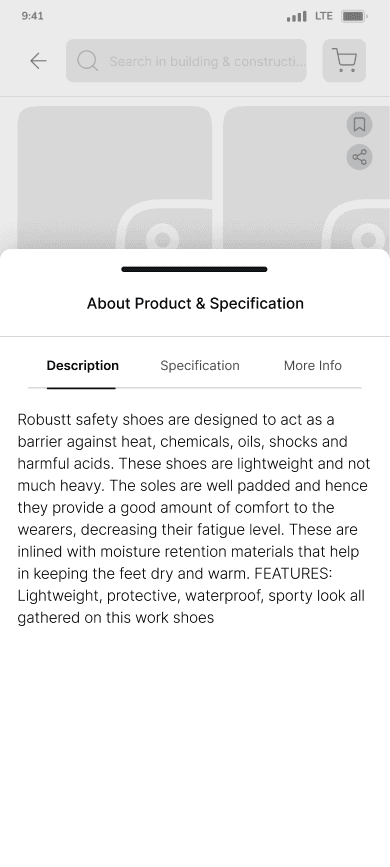

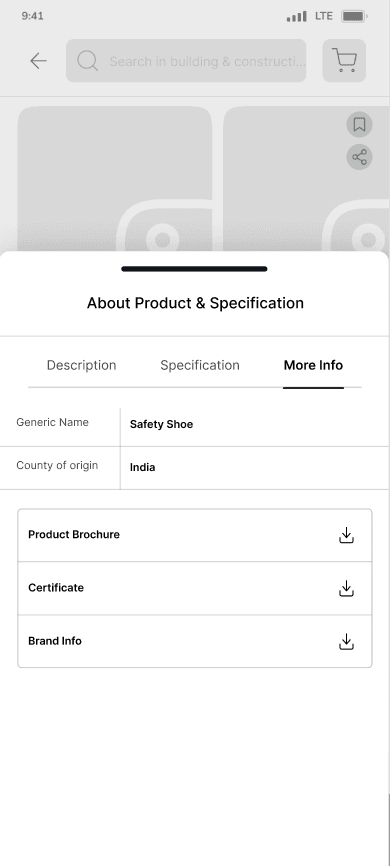

The buyer's core task is finding the right product and getting enough information to feel confident purchasing it. The product listing screen uses a card-based layout for easy scanning, while the product detail view is broken into three tabs (Description, Specification, and More Info) so buyers can go as deep as they need without being overwhelmed upfront.
The buyer's core task is finding the right product and getting enough information to feel confident purchasing it. The product listing screen uses a card-based layout for easy scanning, while the product detail view is broken into three tabs (Description, Specification, and More Info) so buyers can go as deep as they need without being overwhelmed upfront.
Exploration & product detail
Exploration & product detail

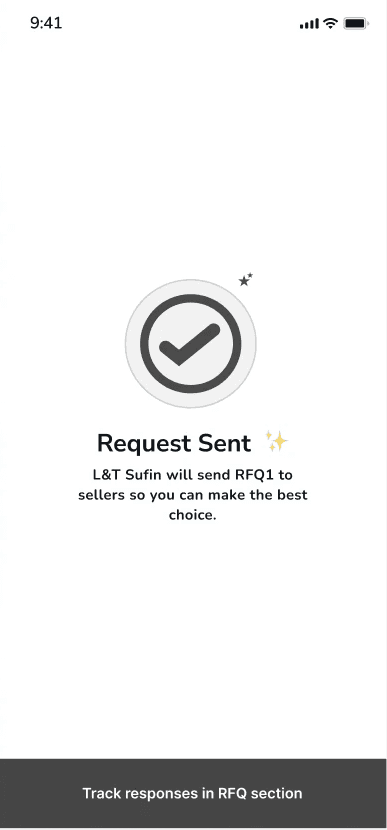
When a standard product doesn't match the buyer's exact requirements, they can edit specifications directly; adjusting size, material, grade, and other attributes and submit a custom RFQ. The RFQ form captures the product, required quotation date, order type, product price type, and payment terms in a single flow. Once submitted, the confirmation screen ("Request Sent ") closes the loop and tells the buyer exactly what happens next, addressing the uncertainty about pricing and delivery that was a core pain point.
When a standard product doesn't match the buyer's exact requirements, they can edit specifications directly; adjusting size, material, grade, and other attributes and submit a custom RFQ. The RFQ form captures the product, required quotation date, order type, product price type, and payment terms in a single flow. Once submitted, the confirmation screen ("Request Sent ") closes the loop and tells the buyer exactly what happens next, addressing the uncertainty about pricing and delivery that was a core pain point.


Custom specifications & RFQ flow
Custom specifications & RFQ flow
Catalogue management
Catalogue management
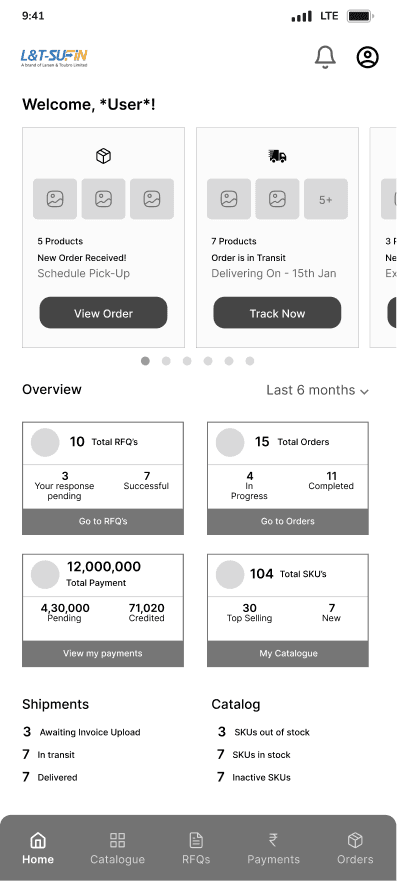
The seller home is a mobile command centre: RFQ count, total orders, payment status, and SKU health visible at a glance. Quick actions (Add Product, List/Store/Publish) sit alongside the stats so sellers can act immediately rather than navigating to a separate section. Sellers can update listings, check what's available, and see what needs attention without needing to be at a desktop. This directly addresses the pain point of catalogue management being time-consuming.
The seller home is a mobile command centre: RFQ count, total orders, payment status, and SKU health visible at a glance. Quick actions (Add Product, List/Store/Publish) sit alongside the stats so sellers can act immediately rather than navigating to a separate section. Sellers can update listings, check what's available, and see what needs attention without needing to be at a desktop. This directly addresses the pain point of catalogue management being time-consuming.



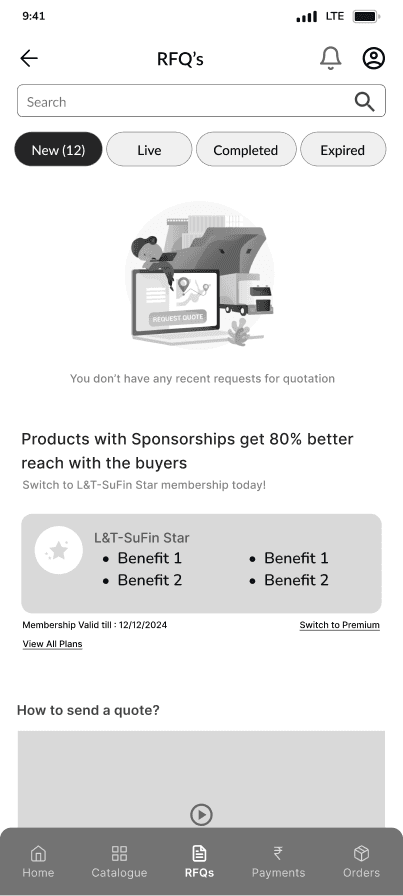
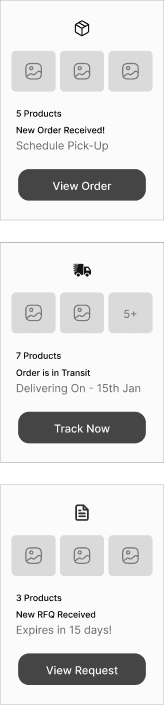
The RFQ screen shows all incoming requests in tabs (New, Live, Completed, Expired) so sellers always know what needs action and what's been handled. Individual RFQ detail pages show buyer information, delivery address, and product specifics, with a Send a Quote CTA. Sponsored placement is surfaced here too, giving sellers a direct path to increasing visibility with buyers.
The RFQ screen shows all incoming requests in tabs (New, Live, Completed, Expired) so sellers always know what needs action and what's been handled. Individual RFQ detail pages show buyer information, delivery address, and product specifics, with a Send a Quote CTA. Sponsored placement is surfaced here too, giving sellers a direct path to increasing visibility with buyers.


RFQ management & quoting
RFQ management & quoting

04 Design Decisions
Two distinct apps,
designed from the ground up
The implementation meant building two genuinely separate interfaces; one tailored entirely to the buyer, one to the seller. Here's how each key design decision translated into screens.
The implementation meant building two genuinely separate interfaces; one tailored entirely to the buyer, one to the seller. Here's how each key design decision translated into screens.
05 Design System
A shared system underneath
two very different apps
On the Design System
On the Design System
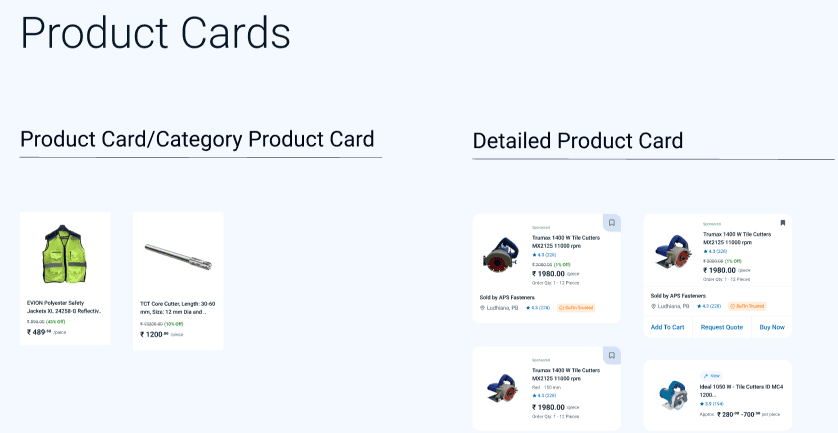
Underpinning both apps is a scalable design system applied uniformly across all product categories. The same card components, states, and navigation patterns work whether the product is a tile cutter or an electrical fitting, which means new categories can be scaffolded without starting from scratch each time.
Underpinning both apps is a scalable design system applied uniformly across all product categories. The same card components, states, and navigation patterns work whether the product is a tile cutter or an electrical fitting, which means new categories can be scaffolded without starting from scratch each time.


On the Drag and Drop
On the Drag and Drop
One of the three design objectives was implementing drag-and-drop for visual page elements for developers. Instead of hardcoding page layouts every time a change was needed, developers could rearrange visual elements directly, saving significant time and reducing costs. The design system made this possible: intuitive enough that a developer could work with it without needing to go back to the design team for every update.
One of the three design objectives was implementing drag-and-drop for visual page elements for developers. Instead of hardcoding page layouts every time a change was needed, developers could rearrange visual elements directly, saving significant time and reducing costs. The design system made this possible: intuitive enough that a developer could work with it without needing to go back to the design team for every update.



06 Impact
A platform both sides of the
marketplace actually want to use
A platform both sides of the marketplace actually want to use
The redesign created a smooth ordering process that works for both buyers and sellers, tailored to individual users based on their profiles, with push notifications and coach screens woven in to keep engagement high and reduce support needs. The result was a platform experience that could genuinely replace the informal workarounds that had been filling the gap.
The redesign created a smooth ordering process that works for both buyers and sellers, tailored to individual users based on their profiles, with push notifications and coach screens woven in to keep engagement high and reduce support needs. The result was a platform experience that could genuinely replace the informal workarounds that had been filling the gap.
Business Impact
Expanded brand reach by bringing both buyer and seller operations fully onto the digital platform
Reduced errors significantly across the transaction process
Enabled sellers to profit directly, without the need for intermediaries
Expanded brand reach by bringing both buyer and seller operations fully onto the digital platform
Reduced errors significantly across the transaction process
Enabled sellers to profit directly, without the need for intermediaries
User Impact
Sellers gained recognition through increased platform conversions
Streamlined procurement process led to a higher conversion rate in the B2B sector
Sellers gained recognition through increased platform conversions
Streamlined procurement process led to a higher conversion rate in the B2B sector
07 Reflection
What I'd do differently,
and what I'd do again
Two months is fast for a platform with this much complexity. It meant decisions that would normally take a week of exploration got made in a day. Looking back, most of them held up, but not all for the reasons I thought at the time.
Two months is fast for a platform with this much complexity. It meant decisions that would normally take a week of exploration got made in a day. Looking back, most of them held up, but not all for the reasons I thought at the time.
I'd have wanted to talk to an actual SME buyer.
Everything I knew about buyer behaviour came through the founders, who knew their users well, but weren't them. There's a specific kind of uncertainty that comes with procurement decisions (new supplier, real money, supply chain consequences) that I was designing around rather than from.
I'd have wanted to talk to an actual SME buyer.
Everything I knew about buyer behaviour came through the founders, who knew their users well, but weren't them. There's a specific kind of uncertainty that comes with procurement decisions (new supplier, real money, supply chain consequences) that I was designing around rather than from.
The drag-and-drop feature taught me that interaction design and spec writing are the same job.
The UX of drag-and-drop is obvious. What's not obvious is every state it can be in, what happens mid-scroll, on a slow connection, when a section empties out. Writing those down before touching the visual design is the work.
The drag-and-drop feature taught me that interaction design and spec writing are the same job.
The UX of drag-and-drop is obvious. What's not obvious is every state it can be in, what happens mid-scroll, on a slow connection, when a section empties out. Writing those down before touching the visual design is the work.
The design system was the quietest win.
It didn't show up in a demo. But it's what makes the platform maintainable; same components across tile cutters and safety helmets and electrical fittings. The investment in building it uniformly is what makes the next category launch not a design project.
The design system was the quietest win.
It didn't show up in a demo. But it's what makes the platform maintainable; same components across tile cutters and safety helmets and electrical fittings. The investment in building it uniformly is what makes the next category launch not a design project.
Thank you for reading:)
Thank you for reading :)
2026 Anoushka Sawardekar
2026 Anoushka Sawardekar